Blog · Data
Bot traffic passed human traffic 18 months ahead of forecast
How Cloudflare revised its bot-traffic forecast, what the earlier crossover means, and how website owners can respond.
By Sascha Hoffmann · Published · Markdown
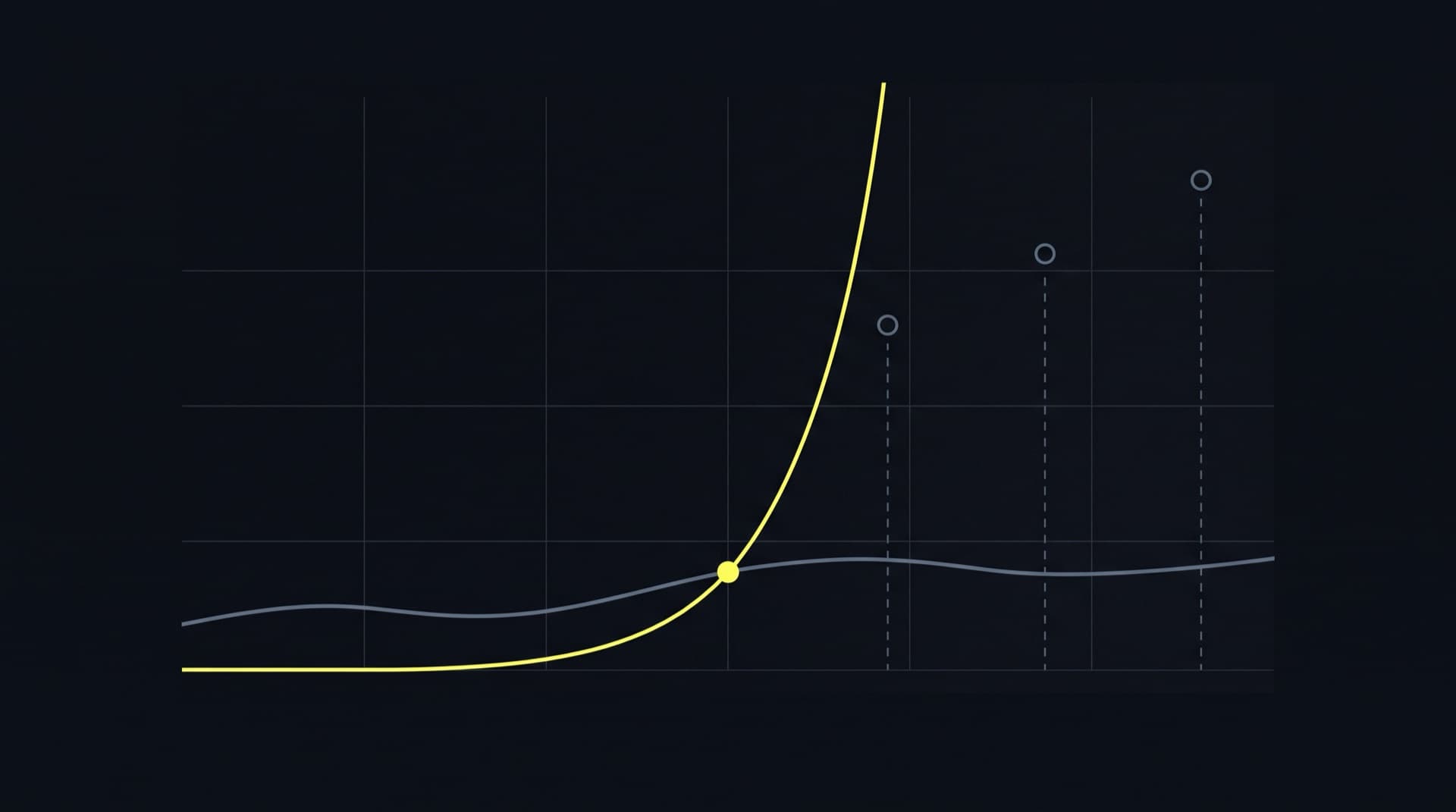
For most of the internet's history, roughly a fifth of all traffic was automated. Search crawlers, uptime monitors, scrapers. That share held steady for years, which is why almost every assumption you have about your audience was built on the other 80 per cent.
That ratio has flipped. Matthew Prince, co-founder and CEO of Cloudflare, told Matt Turck on the Mad Podcast that automated traffic overtook human traffic across Cloudflare's network in the first half of 2026.
The number matters. How they arrived at it matters more.
The forecast was wrong twice, in the same direction
Cloudflare sits in front of a large share of global internet traffic, which makes it one of the few places where this question can be answered rather than estimated. They have been asked it repeatedly, and they have answered it with data each time:
| When asked | Predicted crossover |
|---|---|
| Autumn 2025 | End of 2027 |
| March 2026 | First half of 2027 |
| A few weeks before the interview | Already happened, first half of 2026 |
Read that as a table of predictions and it looks like a company refining an estimate. Read it as a table of errors and it says something harder: the best-instrumented observer of internet traffic on the planet, extrapolating from its own data, was eighteen months out — and then, correcting for that, was still a year out.
Not because the analysis was sloppy. Because the curve is exponential, and people extrapolate exponential curves linearly. Everyone does. Cloudflare did it twice with better data than you have.
That is the actual finding, and it is the one that should change your plan. If your reasoning is "this is coming, we will look at it next year," you are running the same extrapolation that has now failed twice in public. The direction of the error is not random. It has been early, both times.
Why the curve bends: one job, a thousand page views
The mechanism is not mysterious, and it is not scrapers.
Prince uses a shopping example. Say you want to buy a digital camera. Doing it yourself, you might visit five sites — a review, two retailers, a spec sheet, a forum thread. Hand the same job to an agent and it might visit five thousand.
Same person. Same purchase. Same money at the end of it. A thousand times the requests.
This is the part that breaks the old mental model. Traffic used to be a proxy for attention, because a request implied a person deciding to look at something. That link is now severed. The unit of demand stopped being a person and became a task, and a task is happy to read ten thousand pages before it forms an opinion.
Prince expects a thousand times more bot traffic than human traffic within five years, and says that if he had to take the over-under on that figure, he would take the over. Treat that as a projection, not a measurement — he presents it as a bet, and so should you. The crossover is measured. The multiple is a forecast, and forecasts here have a track record of being conservative.
"Bot" does not mean what it used to mean
Worth being precise, because the vocabulary is doing damage.
Prince is blunt about it: agent, bot and crawler are synonyms. They describe the same thing — a machine fetching a resource instead of a person — and which word you pick mostly signals how you feel about it. Call it an agent when you approve. Call it a scraper when you do not.
The important detail is which category is growing. Hostile scraping is roughly flat. Traditional search crawling is flat or slightly down. Essentially all of the growth is agents: something acting on a person's behalf, reading your site in order to answer a question that person asked somewhere else.
That distinction decides whether your instincts help or hurt. Most infrastructure teams have a decade of muscle memory that says bot traffic is a cost to be suppressed. Applied to this wave, that muscle memory blocks your buyers' research assistant and calls it a saving.
Three consequences, in order of how soon they hit you
Your readership is already mostly machines. Not "will be". Is. Every judgement you make about your own pages — this section is too dense, nobody reads the footer, the spec table is ugly so we made it an image — was calibrated against an audience that is now the minority. A machine does not skim, does not bounce, and cannot see your image.
Your infrastructure bill is on the same curve. Prince's point about WordPress is the sharp version: software that costs three or four dollars a month to serve at today's traffic does not quietly cost three or four dollars at a thousand times the volume. Anything you run that scales linearly with requests is on a clock.
The way the internet pays for itself is breaking. For twenty-eight years the model has been advertising, with subscriptions as the smaller second act. Bots don't click on ads. Prince is direct that something has to replace it, and equally direct that nobody knows what yet — Cloudflare is working on per-request micropayments with partners including Coinbase and Stripe, built on HTTP 402, the "Payment Required" status code that has sat unused in the spec since the beginning. To give a sense of scale: he estimates Cloudflare would need to support ten million financial transactions per second on day one, against Visa's fewer than a hundred thousand.
You do not need to have an opinion on how that resolves. You do need to notice that the layer deciding who gets paid for a fetch is being built right now, and that it will have a default for sites that never made a decision.
What is measured, and what is not
Being honest about the evidence, because this space is full of confident numbers with nothing behind them:
- Measured: the crossover happened, on Cloudflare's network, in the first half of 2026. You can watch the same series yourself at radar.cloudflare.com.
- Measured: the historical baseline of roughly 20 per cent automated traffic, held over years.
- A projection: a thousand-to-one ratio within five years. Prince's bet, offered as a bet.
- Not established by any of this: that AI models are already driving meaningful revenue for you. Traffic composition and purchase influence are different questions. The first one is now answered; the second one you have to measure on your own domain.
That last line is the one most of this genre skips. A crawler fetching your pricing page is not a sale. It is a precondition for being in an answer, and being in the answer is a precondition for the sale. Each step needs measuring separately.
What to do this quarter
Not a transformation programme. Four things, in order, none of which takes a week:
- Confirm you are not blocking the traffic you want. Check
robots.txt, then check what your CDN actually does — bot protection sits in front of your application and does not read your robots file. A 403 to GPTBot beats a perfect robots.txt every time. - Confirm your core pages carry their text in the HTML. Home, pricing, product. If the words only appear after JavaScript runs, they do not exist for most of this traffic.
- Confirm your facts are machine-checkable. Prices as numbers in the markup, not in an image. Claims that a model can verify against your own pages rather than take on faith.
- Measure what the models actually say about you. Crawler access tells you whether you can be read. It says nothing about whether you get recommended, whether the price quoted about you is current, or which competitor is named ahead of you.
The first three are technical and cheap. The fourth is the one that tells you whether the first three worked.
The honest summary
One data point does not make a strategy, and a single measurement from a single network — however large — is a sample, not a law of nature.
But the shape of the evidence is unusually clean. A well-instrumented observer made a public forecast, revised it once, and was still wrong in the same direction. When the error is consistently early, the reasonable adjustment is not to split the difference. It is to assume you are later than you think.